You can have the most expensive camera on the market, but if the light fails, the photo fails. In the photo booth business, lighting is not an accessory: it’s what separates an image that the guest proudly shares from one that they delete as soon as they see it. Here we explain the three most common lighting systems and when to use each one.
Why Light Determines the Quality of Your Photo Booth More Than the Camera
An excellent sensor with poor lighting produces a mediocre photo; a modest sensor with well-resolved lighting can produce surprisingly good results. In events with variable ambient light (dark rooms, outdoor at sunset, nightclubs), the lighting system of the photo booth is what guarantees a consistent result, photo after photo.
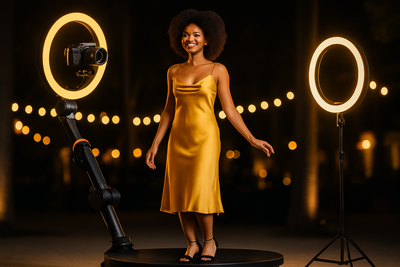
Ring Light: the Favorite of the 360 Photo Booth
How It Works and Why It Flatters Faces
The ring light surrounds the camera lens and produces front and even lighting that eliminates almost all shadows from the face, in addition to creating that characteristic circular reflection in the eyes that is so popular in 360 photo booths and vertical video.
Size and Diameter According to Space
A larger ring produces softer light because it acts as a wider light source relative to the subject; in small spaces or 360 platforms with little margin, you need to balance diameter and distance to maintain that softening effect.
LED Panels: Continuous and Controllable Lighting
Color Temperature: Kelvin Explained
Color temperature is measured in Kelvin: low values (around 3,200K) provide a warm, orange light typical of candlelit interiors or tungsten light; high values (around 5,600K) provide a cool, bluish light similar to daylight. Bicolor LED panels allow you to adjust this value according to the ambient light of the event, something that a fixed flash does not allow you to do in real-time.
Diffusion: Why It Should Never Be Direct
An LED panel without a diffuser produces harsh light, with very pronounced shadow edges. A simple diffusion panel or a translucent fabric in front of the LED softens that transition and avoids the "ID photo" look in printed copies.
Studio Flash: Power for Classic Photo Booth
Synchronization with the Camera
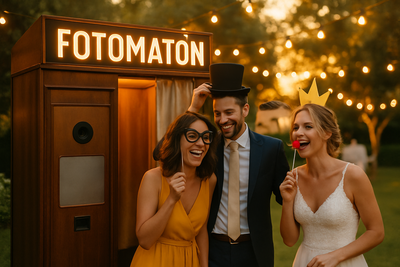
The studio flash, synchronized with the camera shutter, provides a very powerful burst of light in a fraction of a second, freezing motion even in photos with several people moving at the same time, which is common in party or nightclub photo booths.
Advantages Over Continuous Light
Compared to the ring light or LED panel, the flash allows you to work with tighter apertures (greater depth of field) without needing to increase the camera's ISO sensitivity, resulting in less digital noise in the final image, especially relevant for large format printed copies.
Comparison: Ring Light vs LED vs Flash
| System | Best For | Main Advantage | Limitation |
|---|
| Ring Light | 360 Photo Booth, vertical video | Even face, reflection in eyes | Limited control of light direction |
| LED Panel | Fixed photo booth, magic mirror | Adjustable color temperature | Less power than a flash |
| Studio Flash | Classic photo booth, nightclubs, groups | Freezes motion, maximum sharpness | Requires correct synchronization |
Typical Lighting Mistakes in Photo Booth
Mixing Color Temperatures
Combining warm ambient light with a cold-configured LED panel produces photos with unflattering skin tones that are difficult to correct later. Always adjust your equipment's temperature to the dominant light of the space.
Direct Light Without Diffuser
Direct light, without any diffusion element in front, creates harsh highlights on the skin and marked shadows behind the subject, a common problem when setting up the equipment in a hurry just before guests arrive.
Hard Shadows Under the Eyes
When the light source is too high relative to the subject's face, marked shadows are created under the eyes and nose. Lowering the height of the main light slightly, to eye level or just above, resolves most of these cases.
Background Light: Separating the Subject from the Backdrop
An additional light pointing at the background, independent of the one illuminating the people, prevents the subject from visually blending with the backdrop behind, especially in dark backgrounds or in nightclub photo booths where ambient lighting is very dim. It’s a small detail that makes the difference between a flat photo and one with depth.
Diffusion Accessories and Stands
Foldable softboxes, translucent umbrellas, and stands with adjustable heads allow you to adapt the angle of the light according to the average height of the guests at each event, from a communion with children to a wedding with adults. Investing in stable stands also prevents a light from tipping over with the hustle and bustle of a busy event.
How to Set Up a Basic and Effective Lighting Scheme
For most events with a single shooting point (classic photo booth or magic mirror), a simple scheme works well: a diffuse main source at eye level, a softer secondary source to fill shadows on the opposite side, and, if the budget allows, a background light to separate the subject from the backdrop. In a 360 photo booth, the ring light usually suffices as the sole source thanks to its centered front position.
Conclusion: Light Is the Investment That Shows the Most
Before thinking about the next camera upgrade, review your lighting system: it’s the change with the most visible impact for every euro invested. Find ring lights, LED panels, and lighting accessories in our photo booth accessories collection, or discover already integrated equipment in our 360 photo booth collection.