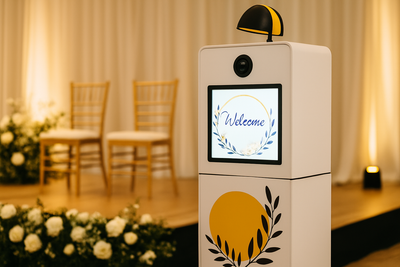
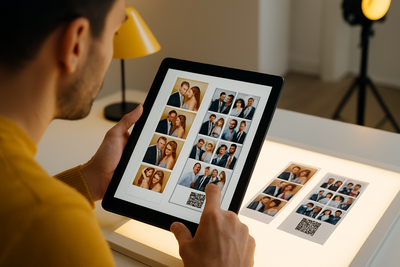
At a fair, visitors walk past dozens of booths in a single aisle and remember less than half the next day. The photo booth solves a very specific problem: it gives a reason to stop at the booth for more than ten seconds, and those ten seconds are what a salesperson needs to capture a qualified contact instead of handing out business cards that no one looks at afterward.
Why the Photo Booth Works Better than a Simple Photocall at a B2B Booth
A static photocall only generates a photo. A well-configured photo booth generates a photo and a contact detail, because the process of collecting the image (via email or QR) goes through a form. The difference compared to a traditional lead capture form is that here the visitor provides the detail in exchange for something they are already eager to receive: their photo.
The Step-by-Step Capture Mechanism
- The visitor takes a photo or video in the booth at the stand.
- Before receiving the copy, they complete a brief form (name, email, company, position) on the screen itself.
- They receive the photo instantly via email or through a QR code that leads to an online gallery.
- The detail is recorded in the photo booth platform, ready for export.
What Data to Ask For (and What Not to Ask For)
Short Form = More Conversion
The more mandatory fields there are, the fewer people complete the form before moving on to another booth. The practical recommendation is to limit it to the essentials to qualify the lead.
| Field | Mandatory | Reason |
|---|
| Name | Yes | Personalize commercial follow-up |
| Email | Yes | Send the photo and use it as a contact channel |
| Company | Yes | Qualify the lead as relevant B2B |
| Position | Optional | Prioritize follow-up based on decision-making power |
| Phone | Optional | Only if the sales team follows up by phone |
Consent and Data Protection
The form must include a clear consent checkbox for the commercial use of the data, in accordance with GDPR, before the visitor provides their email. This is a point that should be reviewed with the legal department of each exhibiting company, not something that is improvised on the setup day.
Integration with CRM: From the Photo to the Sales Pipeline
The real value of this capture appears when leads do not end up on an Excel sheet exported at the end of the fair. Many photo booth management platforms allow exporting the contact list in CSV format compatible with common CRMs, or even connecting directly via integration, so that the sales team receives the lead with the photo attached on the same day of the event.
Best Practices for Post-Fair Follow-Up
- Send a follow-up email within the first 48 hours, with the photo as a hook ("here's your photo from our booth at [fair]").
- Segment the sending according to position or declared interest, if that information was collected.
- Mark in the CRM the exact source ("lead-photo booth-fair X") to measure the return of that specific action compared to others at the booth.
Designing the Photo Booth for a B2B Stand
Consistent Branding with the Rest of the Booth
The vinyl, welcome screen, and print template should carry the brand identity of the exhibiting company, not a generic party design. A photo booth with a wedding aesthetic at a software conference feels out of place and detracts from the seriousness of the booth.
Location Within the Booth
Place it in a visible spot from the main aisle, but without blocking access to the counter where the sales team attends. The line that forms around the photo booth is, in itself, a visual attraction for those passing by.
What Photo Booth Format to Choose for Fairs
For booths with limited space, a compact fixed photo unit is usually more practical than a 360 photo booth, which requires more free space around it for the platform to rotate. If the booth has ample space and the goal is to generate eye-catching content for social media in addition to leads, the 360 does justify the investment in square meters.
Measuring the Return of the Photo Booth Compared to Other Booth Actions
A common mistake at fairs is treating the photo booth as an isolated entertainment expense, without comparing its performance to other booth actions (demos, giveaways, scheduled meetings). At the end of the event, it is advisable to cross three very simple figures: number of photos taken, number of forms completed, and number of those leads that result in a sales meeting in the following weeks.
Useful Questions for the Post-Fair Meeting
- What percentage of the photos ended up in a completed form?
- How many of those leads responded to the follow-up email?
- Is the cost of the photo booth (rental or amortization if owned) justified against the volume and quality of the contacts obtained?
With this data, deciding whether to repeat the action at the next fair, or whether to adjust the form or the booth design, stops being an intuition and becomes a decision based on concrete numbers from the company itself.
An Important Nuance
The photo booth captures attention, but the form is what converts that attention into a usable lead: without that step, the action remains simple booth animation, no matter how well received it is.
Conclusion: the Photo Booth as a Capture Tool, Not Just Entertainment
In a B2B environment, the photo booth stops being an entertainment element and becomes a data capture point with high conversion, as long as the form is short and the subsequent follow-up is planned before the fair. If you are preparing a booth and need equipment or signage accessories, in our store you will find options tailored to both small spaces and large booths.